
Criminal Cases in Elk County Courts
The Court of Common Pleas of Elk and Cameron Counties forms Pennsylvania's 59th Judicial District. Its Elk County side hears felonies and misdemeanors held for court, pleas, trials, sentences, summary appeals, and related criminal miscellaneous matters. The Clerk of Courts at the Elk County Courthouse keeps those criminal case files. Although the elected office is styled Prothonotary and Clerk of Courts, readers seeking a criminal docket should ask for the Clerk side.
Magisterial district judges handle complaints, preliminary arraignments, bail, preliminary hearings, traffic matters, non-traffic summaries, and other qualifying minor cases. St. Marys, Ridgway, and Johnsonburg do not have separate municipal criminal courts. An Elk County criminal case held for court receives a Common Pleas docket whose pattern begins CP-24-CR.
The official county Clerk page shows the local office that maintains those files.
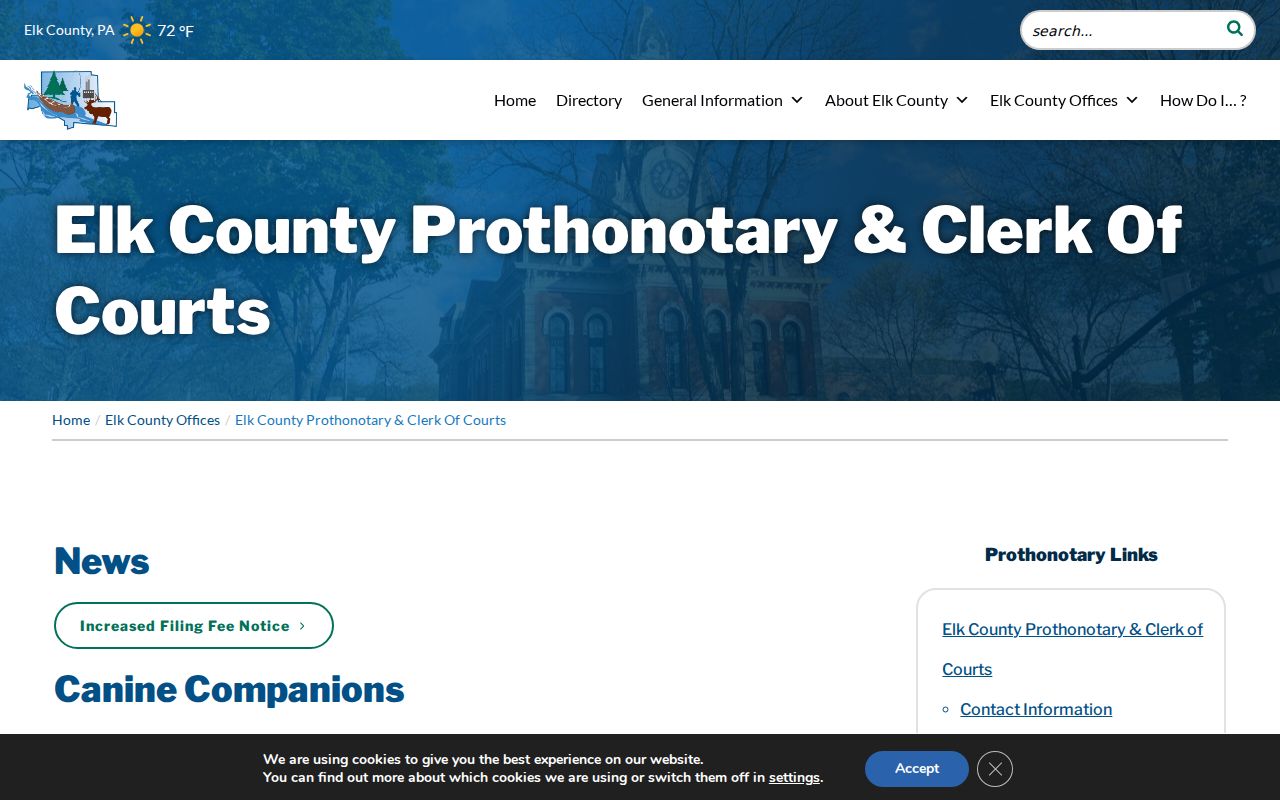
That office is the proper local contact for public Common Pleas papers and certified copies.
Elk County Court Case Routes
Choosing the right court is the first local hurdle. A new felony or misdemeanor complaint often appears first on a magisterial docket, not under Common Pleas. If the charge is held for court or the hearing is waived, the district attorney may file a criminal information and a separate Common Pleas docket develops. A summary appeal goes directly into the Common Pleas Summary Appeal category, while bail appeals, contempt, search-warrant matters, and similar proceedings may sit under Miscellaneous.
| Court or office | Elk County criminal role | Access route |
|---|---|---|
| Magisterial district court | Complaint, preliminary stages, bail, summary and traffic matters | UJS and the filing MDJ office |
| Common Pleas / Clerk of Courts | Held-for-court cases, pleas, trials, sentences, and summary appeals | UJS and 250 Main Street |
| Pennsylvania appellate courts | Appeals from the trial court | Statewide UJS portal |
Note: A magisterial case held for court is not a guilty finding; it marks the case's move toward Common Pleas review.
How to Search Case Records
The free Unified Judicial System Case Search covers public Common Pleas, magisterial district, and appellate dockets. Start broad, verify Elk County, then open the docket-sheet report. A results row is not enough because one docket can contain several charges with different grades and outcomes.
- Select Courts of Common Pleas, Participant Name, Elk County, and Criminal. Enter the surname and first name, leaving extra filters blank at first.
- Check for the CP-24-CR docket pattern. Open the docket sheet and confirm the county, filing date, originating district docket, and case status.
- Repeat the search under Magisterial District Courts. Choose the correct district and Criminal, Traffic, or Non-Traffic because the county filter alone may miss the lower-court file.
- Read each offense row, docket event, bail entry, scheduled proceeding, disposition, sentence, and financial section in context.
- Ask the filing MDJ for its paper record or contact Elk County Clerk of Courts for public Common Pleas papers and certification not available online.
| Field label | Type | Required | Use |
|---|---|---|---|
| Court Type | Dropdown | Yes | Common Pleas, Magisterial District, Appellate, or Philadelphia Municipal |
| Search By | Dropdown | Yes | Participant Name, Docket Number, or another exposed method |
| Last / First Name | Text | Name search | Begin with surname; shorten or clear first name if needed |
| County / District | Dropdown | Optional | Select Elk for Common Pleas or the district for an MDJ case |
| Docket Type | Dropdown | Recommended | Criminal, Summary Appeal, Miscellaneous, Traffic, or Non-Traffic |
| Date Filed | Date range | No | Narrows a broad set after the first search |
The official UJS screen shows the controls used for an Elk County criminal court case search.
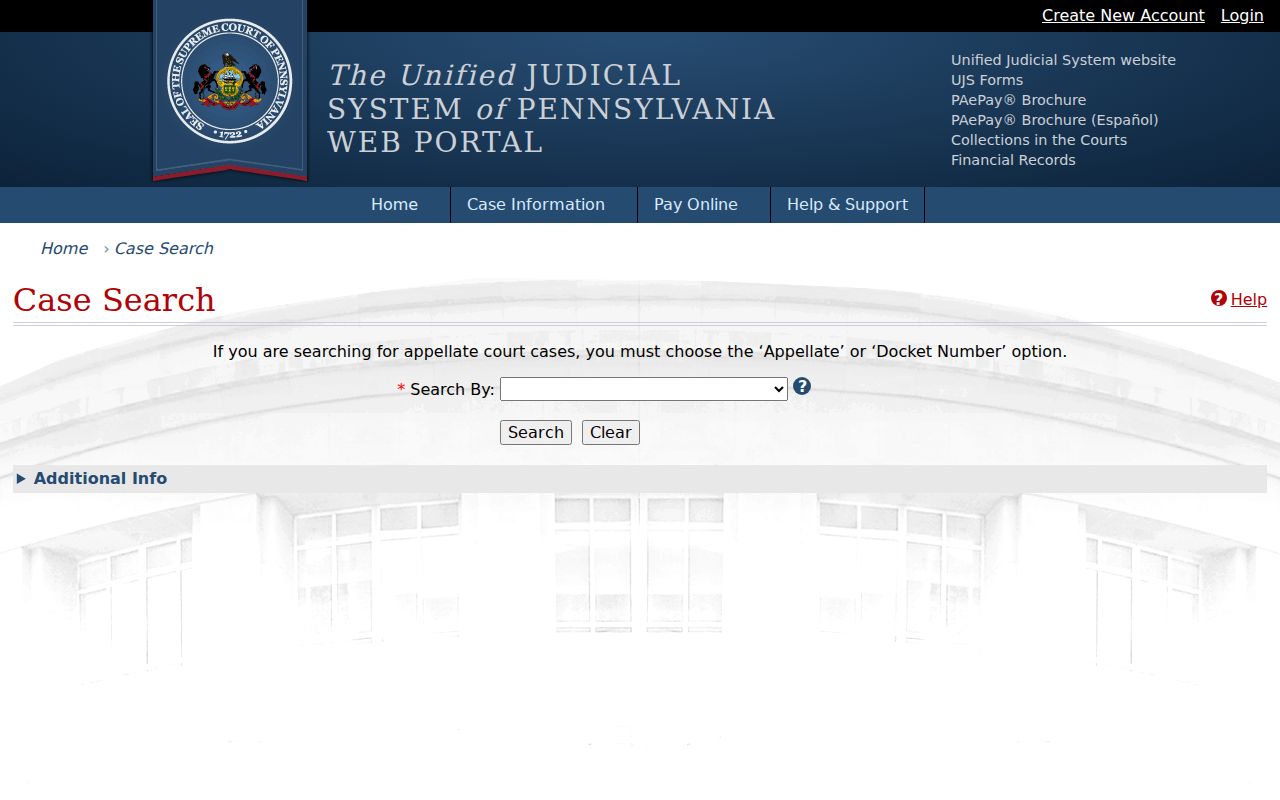
Use Clear before retrying with fewer fields, as the court's help instructions recommend.
Reading an Elk County CP-24-CR Docket
A CP-24-CR docket is case-centered. Its header identifies the court, docket number, caption, judge, status, and filing dates. Participant and counsel sections connect the case to roles, while the originating docket links the Common Pleas matter back to its magisterial stage. Bail, hearing, and scheduling entries record procedure, not guilt.
For a sound Elk County case match, compare the docket number, court, filing date, originating district record, and public role information. A shared name alone does not establish identity.
Read the offense table line by line. Each charge carries a sequence, statute, description, grade, and disposition. A case-level label such as disposed does not mean that every charge ended in conviction. The public docket may also show the arresting agency, orders, plea or verdict events, sentencing terms, and fines, costs, restitution, and payment activity. An unpaid total does not identify which type of obligation remains without checking the detail.
The judiciary's public court-case information page provides useful context for public docket access.
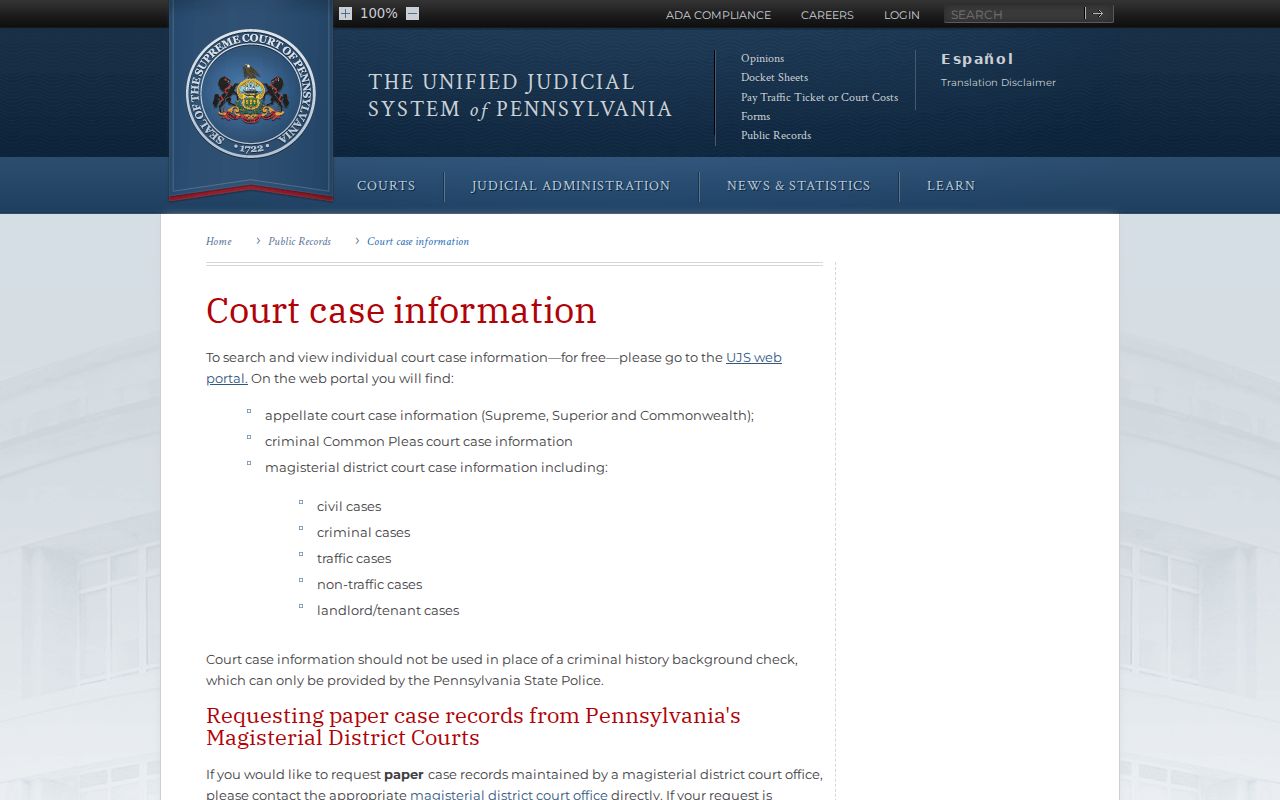
The portal may list an order without making the filed document itself downloadable.
What the Case File Shows
The public docket is a chronology, while the courthouse file can contain the papers behind those entries. For an Elk County criminal case, the most useful fields establish which allegations were formally filed, what happened to each charge, and what order controls the outcome.
| Case number and court | The CP-24-CR number, Elk County court, status, judge, and key filing dates. |
|---|---|
| Charging document | The complaint at the lower-court stage and the district attorney's criminal information in Common Pleas. |
| Docket entries | Filed motions, orders, arraignment, conferences, pleas, verdict, and sentencing events. |
| Hearing dates | Scheduled proceedings with date, time, place, type, and judicial officer when public. |
| Charge outcomes | Each offense's statute, grade, and disposition, including dismissal, acquittal, plea, or verdict. |
| Sentence and finance | Confinement, probation, concurrent or consecutive terms, fines, costs, restitution, and payment data. |
A criminal complaint records initial allegations. The later information may amend, add, consolidate, or withdraw charges, so the first charge list should never be treated as the final one.
Elk County Charge-by-Charge Outcomes
Pennsylvania docket terms carry precise meanings. Disposition is the outcome of a charge or case. Nolle prosequi means the prosecution formally declines to continue a charge, subject to court practice. Dismissal ends a charge without conviction, while acquittal is a not-guilty decision. Accelerated Rehabilitative Disposition is pretrial diversion, not a conviction, and its docket should be read through completion and any later dismissal.
- Held for court
- The magisterial-stage threshold was met or waived; guilt has not been decided.
- Information
- The district attorney's formal Common Pleas charging document.
- Plea
- The defendant's formal response; a guilty plea can lead to conviction and sentence.
- Nolle prosequi
- A formal decision by the prosecution not to continue a charge.
- ARD
- A Pennsylvania diversion path that may end in dismissal and later expungement eligibility after successful completion.
Note: A dismissal does not automatically erase the police, booking, repository, or court trail created before the final outcome.
Stages of a Criminal Case
An Elk County court record changes as the matter moves from the filing MDJ to the trial court. The complaint starts the judicial trail. Preliminary arraignment addresses rights and bail, then the preliminary hearing tests whether the case proceeds. If held for court, the district attorney files the information in Common Pleas. Arraignment, pretrial motions, plea negotiations or trial, disposition, and sentence follow as applicable.
Case flow: Charges Filed › Arraignment › Pretrial › Plea or Trial › Disposition › Sentencing
That sequence explains why a new case may appear first under a district court and only later as CP-24-CR. It also explains why booking charges can differ from the information eventually filed. For the custody event that precedes the court file, the separate Elk County arrest history page identifies the agency and prison channels.
When Elk County Cases Do Not Appear
A blank UJS search does not prove that no case exists. First clear the form, choose Participant Name again, search a broad surname and first name, and leave other fields blank. Try each relevant docket type. For a magisterial matter, search the district number. Recent entries may not yet be posted, so a time-sensitive request belongs with the filing office.
The UJS search help page explains why a public case may not be found.
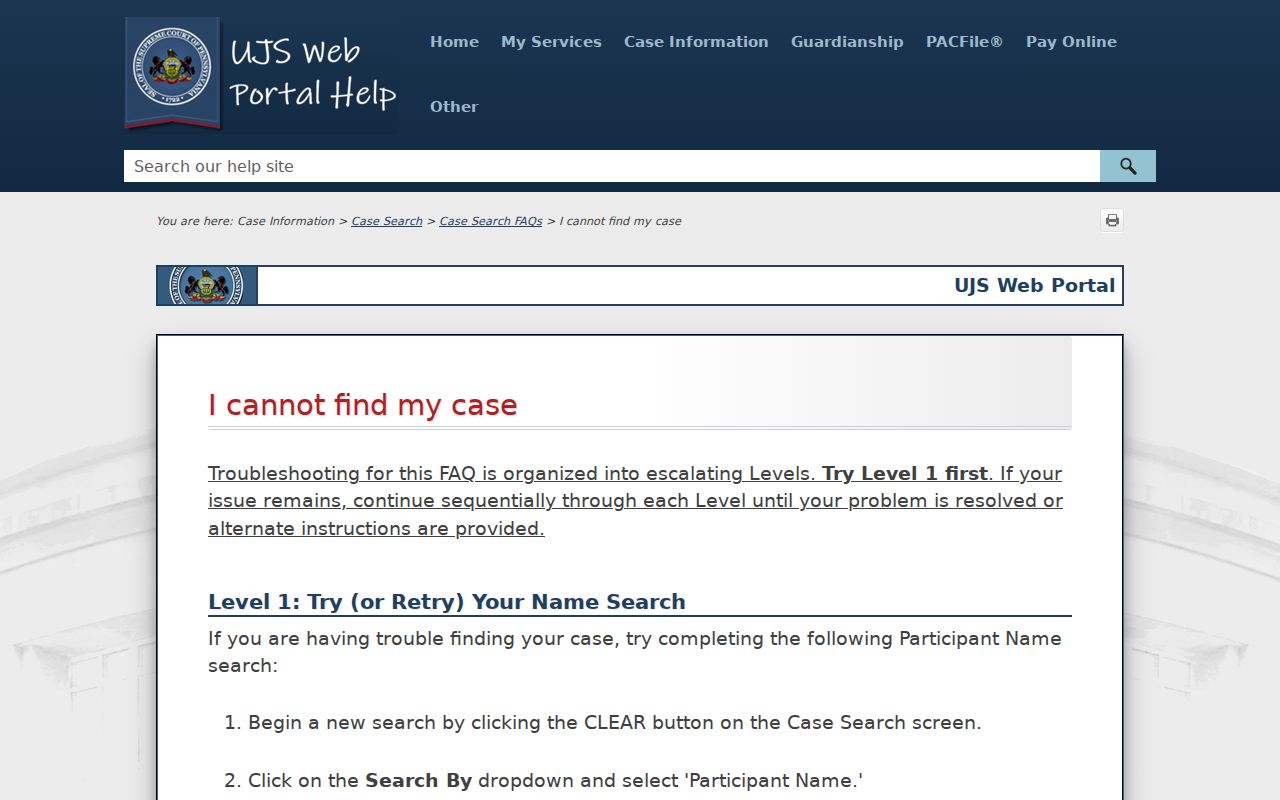
Juvenile, sealed, expunged, pending-expungement, limited-access, and retention-destroyed records are not displayed publicly.
Elk County Paper Files at 250 Main
The Elk County Courthouse at 250 Main Street in Ridgway houses the Common Pleas court and Clerk of Courts. The county lists weekday hours of 8:30 a.m. to 4:00 p.m. and the main number as 814-776-1161. Ask for Clerk of Courts when seeking a criminal file. Paper magisterial records stay with the filing MDJ, whose office details appear through UJS Show Details and the official directory.
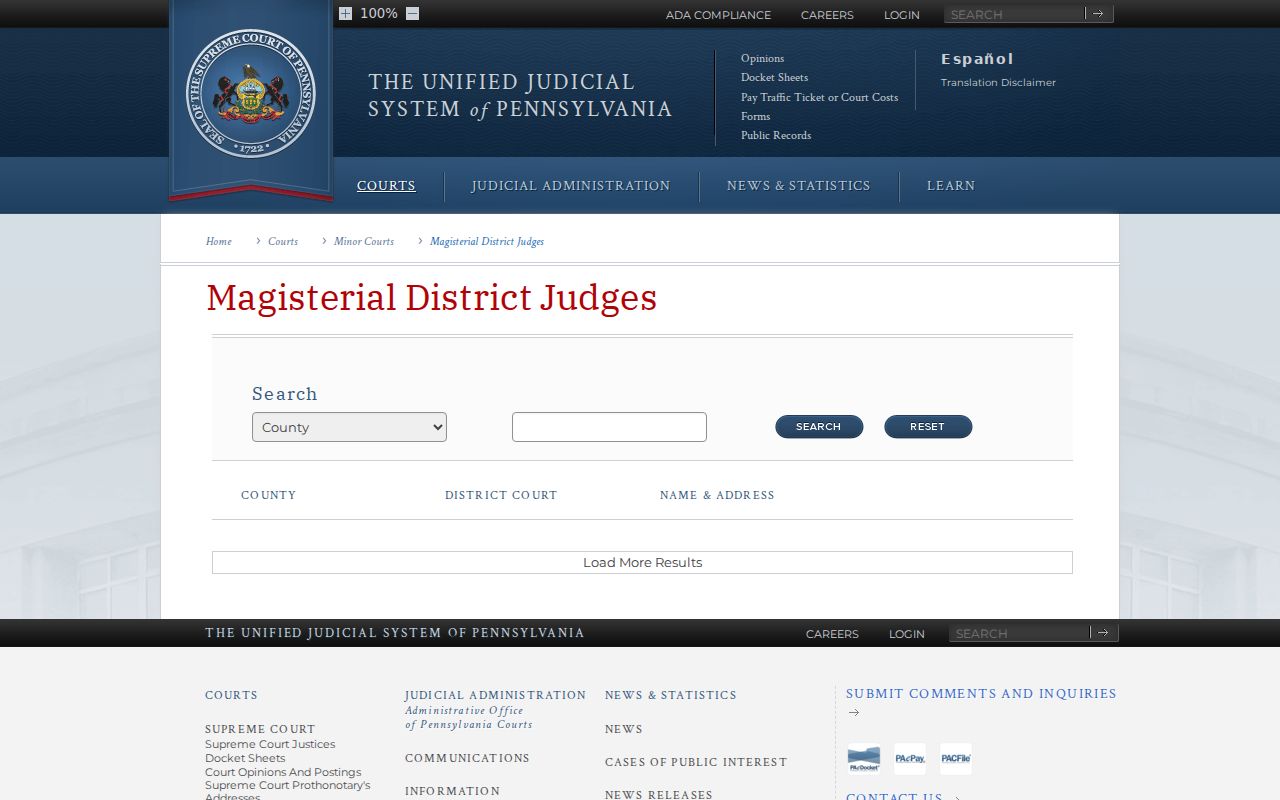
The official magisterial district judge resource identifies this Pennsylvania court level.
Copies and certifications follow the Clerk's current fee schedule, but the research did not locate an accessible current criminal-copy price, so confirm cost before ordering.
Access & Restrictions
Public Elk County court records follow Pennsylvania judicial access rules, not the county's ordinary Right-to-Know route. The Case Records Public Access Policy controls case access and redaction. Court financial and administrative requests fall under Rule 509. County-agency records use RTKL. Those lanes are not substitutes for requesting a defendant's docket from the Clerk or filing MDJ.
Victim identity, protected identifiers, juvenile material, and records subject to sealing, expungement, or limited access may be redacted or withheld. Online views can be narrower than a public paper file, yet a courthouse request does not override a lawful restriction. Pennsylvania's Criminal History Record Information Act also distinguishes public judicial information from restricted investigative and intelligence material.
For a missing public document listed on the docket, ask the Clerk whether it can be inspected or copied instead of assuming the portal contains the whole file. Public access is determined record by record, and a listed event does not guarantee that its underlying paper can be downloaded.